Text
“Theraps” – There Is No Other Way…
In this 1998 article for Kontrabasista, the magazine of the Polish Double Bass Society, Aleksander Gabryś writes about Iannis Xenakis’ ‘Theraps’ as a physical, technical and metaphysical boundary work for solo double bass.
English translation of the Polish printed article from 1998. The author confirms “wyrazowo-ekspiacyjnych”; the printed “wyrazowo-ekspilacyjnych” is a typo.
Kontrabasista, Wrocław 1998
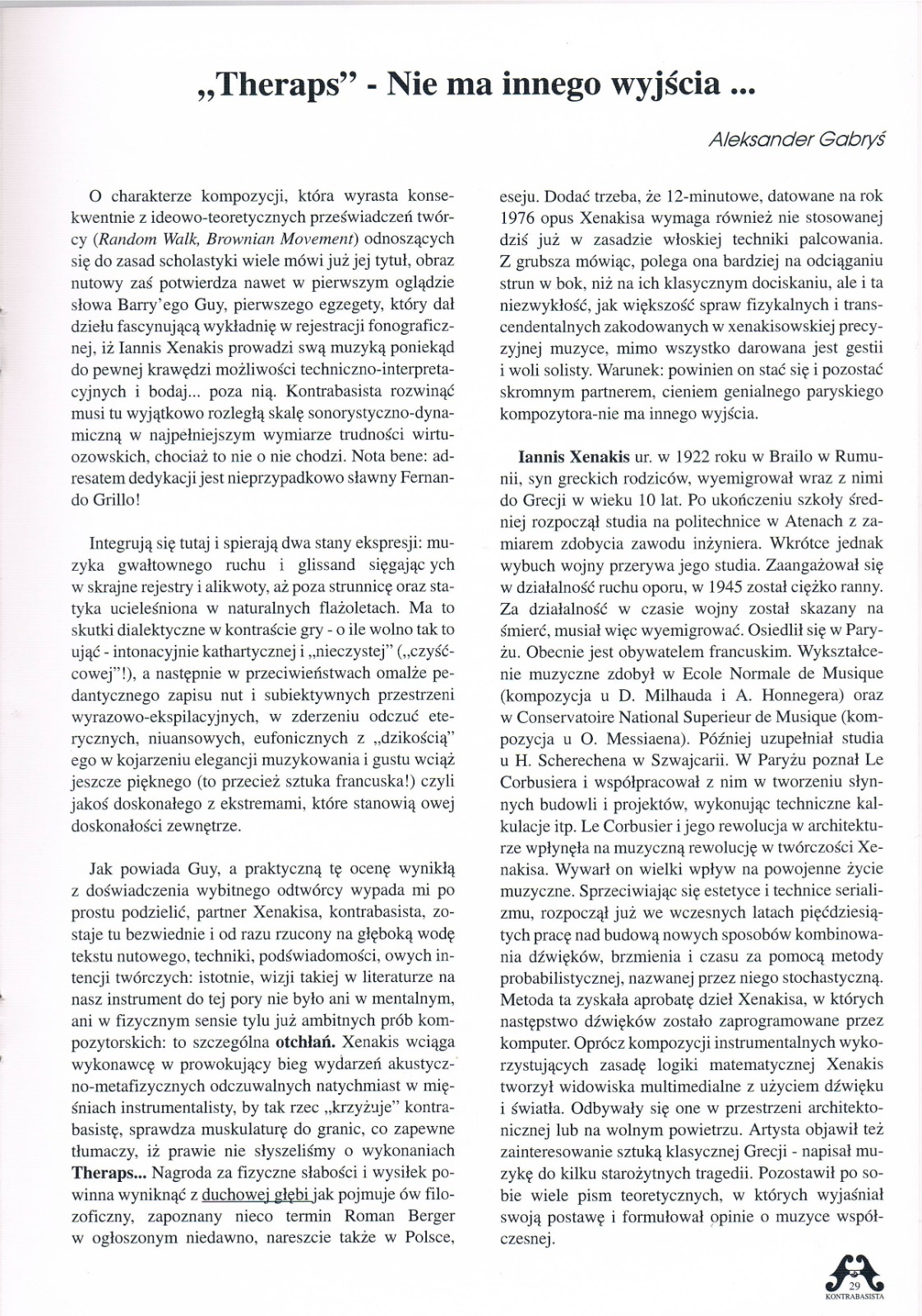
“Theraps” – There Is No Other Way…
The title already says much about the character of a composition that grows consistently out of the composer’s ideological and theoretical convictions (Random Walk, Brownian Movement), referring to the principles of scholasticism; and even at first glance the image of the score confirms the words of Barry Guy, the first exegete, who gave the work a fascinating interpretation in recording: that Iannis Xenakis leads his music, in a sense, to a certain edge of technical and interpretive possibility and perhaps... beyond it. The double bassist must unfold here an exceptionally broad sonoristic and dynamic scale in the fullest dimension of virtuoso difficulty, although that is not what this is about. Nota bene: the dedicatee is, not by accident, the famous Fernando Grillo!
Two states of expression come together here and contend with one another: a music of violent motion and glissandi reaching into extreme registers and overtones, even beyond the fingerboard, and a static state embodied in natural harmonics. This has dialectical consequences in the contrast of playing that is - if one may put it this way - intonationally cathartic and “impure” (“purgatorial”!), and then in the oppositions between an almost pedantic notation and subjective spaces of expressive expiation, in the collision of ethereal, nuanced, euphonic sensations with the “wildness” of the ego, in the association of the elegance of music-making and of a taste still beautiful (this is, after all, French art!), that is, somehow perfect, with extremes that constitute the outside of that perfection.
As Guy says - and this practical assessment, arising from the experience of an outstanding interpreter, I simply have to share - Xenakis’ partner, the double bassist, is here unwittingly and at once thrown into the deep water of the score, of technique, of the subconscious, of those creative intentions. Indeed, in the literature for our instrument there has not yet been such a vision, in either the mental or the physical sense, despite so many ambitious compositional attempts: it is a particular abyss. Xenakis draws the performer into a provocative course of acoustic and metaphysical events that are felt immediately in the instrumentalist’s muscles; he, so to speak, “crucifies” the double bassist, tests the musculature to its limits, which surely explains why we have heard almost nothing of performances of Theraps... The reward for physical frailty and effort should arise from spiritual depth, as Roman Berger understands that philosophical, somewhat forgotten term in an essay published recently, at last also in Poland. It must be added that Xenakis’ twelve-minute opus, dated 1976, also requires the Italian fingering technique, now basically no longer used. Roughly speaking, it consists more in pulling the strings sideways than in pressing them down in the classical manner; but this unusual feature too, like most of the physical and transcendental matters encoded in Xenakis’ precise music, is nevertheless entrusted to the discretion and will of the soloist. The condition: the player should become and remain a modest partner, the shadow of the brilliant Parisian composer - there is no other way.
Iannis Xenakis, born in 1922 in Brăila, Romania, the son of Greek parents, emigrated with them to Greece at the age of ten. After completing secondary school he began studies at the Polytechnic in Athens with the intention of becoming an engineer. Soon, however, the outbreak of war interrupted his studies. He became involved in the resistance movement and in 1945 was seriously wounded. For his wartime activity he was sentenced to death, and therefore had to emigrate. He settled in Paris. At present he is a French citizen. He received his musical education at the École Normale de Musique (composition with D. Milhaud and A. Honegger) and at the Conservatoire National Supérieur de Musique (composition with O. Messiaen). Later he continued his studies with Hermann Scherchen in Switzerland. In Paris he met Le Corbusier and collaborated with him in the creation of famous buildings and projects, carrying out technical calculations, etc. Le Corbusier and his revolution in architecture influenced the musical revolution in Xenakis’ work. Xenakis exerted a great influence on postwar musical life. Opposing the aesthetics and technique of serialism, he began already in the early 1950s to work on constructing new ways of combining sounds, sonority and time by means of a probabilistic method, which he called stochastic. This method found application in Xenakis’ works in which the succession of sounds was programmed by computer. In addition to instrumental compositions using the principle of mathematical logic, Xenakis created multimedia spectacles employing sound and light. They took place in architectural spaces or in the open air. The artist also revealed an interest in the art of classical Greece - he wrote music for several ancient tragedies. He left many theoretical writings in which he explained his position and formulated opinions on contemporary music.