Text
Bassolo — review in The Strad
David Kettle’s The Strad review of the double album Bassolo — XX/XXI Centuries’ Contrabass Music, released by DUX.
David Kettle’s review in The Strad presents the double album Bassolo — XX/XXI Centuries’ Contrabass Music as a recommended release.
Verified transcription prepared from the supplied review scan.
The Strad — review scan
“Ear-bending playing from a master of the double bass”
“This is an astonishingly generous and accomplished two-disc set…”
“His arresting performance of Xenakis’s Theraps, though, is worth the price of the disc alone…”
“Gabryś here shows himself to be an exceptionally talented and versatile bassist.”
Bassolo — review in The Strad
theStrad recommends…
BASSOLO Works by R. Gabryś, Szalonek, Boguslawski, Cage, Grisey, Lauck, Dziadek, Roth, Scelsi, Oehring, Pritchard, Knüsel, Lee, Iršai & Xenakis
Aleksander Gabryś (double bass) Consuelo Giulianelli (harp) Jürg Henneberger, Daniel Buess (piano) Silesian Philharmonic Symphony Orchestra/Czeslaw Grabowski, Camerata Impuls Chamber Orchestra/Malgorzata Kaniowska
DUX 0800-1 (TWO DISCS)
Ear-bending playing from a master of the double bass
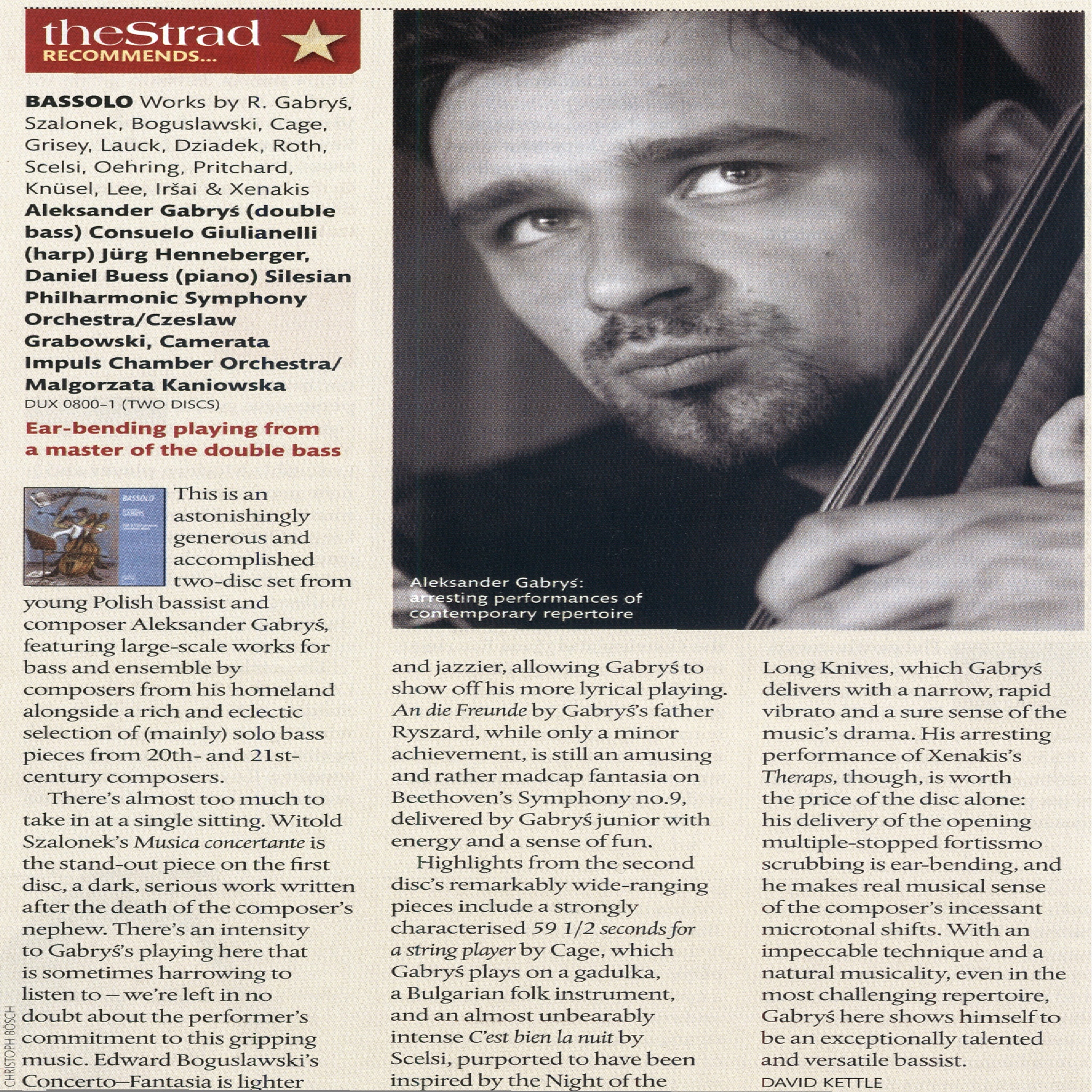
Aleksander Gabryś: arresting performances of contemporary repertoire
This is an astonishingly generous and accomplished two-disc set from young Polish bassist and composer Aleksander Gabryś, featuring large-scale works for bass and ensemble by composers from his homeland alongside a rich and eclectic selection of (mainly) solo bass pieces from 20th- and 21st-century composers.
There’s almost too much to take in at a single sitting. Witold Szalonek’s Musica concertante is the stand-out piece on the first disc, a dark, serious work written after the death of the composer’s nephew. There’s an intensity to Gabryś’s playing here that is sometimes harrowing to listen to — we’re left in no doubt about the performer’s commitment to this gripping music. Edward Boguslawski’s Concerto–Fantasia is lighter and jazzier, allowing Gabryś to show off his more lyrical playing. An die Freunde by Gabryś’s father Ryszard, while only a minor achievement, is still an amusing and rather madcap fantasia on Beethoven’s Symphony no.9, delivered by Gabryś junior with energy and a sense of fun.
Highlights from the second disc’s remarkably wide-ranging pieces include a strongly characterised 59 1/2 seconds for a string player by Cage, which Gabryś plays on a gadulka, a Bulgarian folk instrument, and an almost unbearably intense C’est bien la nuit by Scelsi, purported to have been inspired by the Night of the Long Knives, which Gabryś delivers with a narrow, rapid vibrato and a sure sense of the music’s drama. His arresting performance of Xenakis’s Theraps, though, is worth the price of the disc alone: his delivery of the opening multiple-stopped fortissimo scrubbing is ear-bending, and he makes real musical sense of the composer’s incessant microtonal shifts. With an impeccable technique and a natural musicality, even in the most challenging repertoire, Gabryś here shows himself to be an exceptionally talented and versatile bassist.
DAVID KETTLE