Texte
Bassolo — critique dans The Strad
Critique de David Kettle dans The Strad consacrée au double album Bassolo — XX/XXI Centuries’ Contrabass Music, publié par DUX.
La critique de David Kettle dans The Strad présente le double album Bassolo — XX/XXI Centuries’ Contrabass Music comme une publication recommandée.
Le document source est conservé en anglais ; l’édition française ci-dessous a été préparée directement à partir de l’original.
Transcription anglaise vérifiée à partir du scan de la critique fourni.
The Strad — scan de la critique
« Un jeu à vous tordre l’oreille, signé par un maître de la contrebasse »
« C’est un coffret de deux CD étonnamment généreux et abouti… »
« Mais son interprétation saisissante de Theraps de Xenakis justifie à elle seule le prix du disque… »
« Gabryś se révèle ici comme un contrebassiste exceptionnellement doué et polyvalent. »
Bassolo — critique dans The Strad
Édition française
theStrad RECOMMENDS...
BASSOLO Œuvres de R. Gabryś, Szalonek, Bogusławski, Cage, Grisey, Lauck, Dziadek, Roth, Scelsi, Oehring, Pritchard, Knüsel, Lee, Iršai et Xenakis
Aleksander Gabryś (contrebasse), Consuelo Giulianelli (harpe), Jürg Henneberger, Daniel Buess (piano), Orchestre symphonique de la Philharmonie de Silésie / Czesław Grabowski, Orchestre de chambre Camerata Impuls / Małgorzata Kaniowska
DUX 0800-1 (deux CD)
Un jeu à vous tordre l’oreille, signé par un maître de la contrebasse
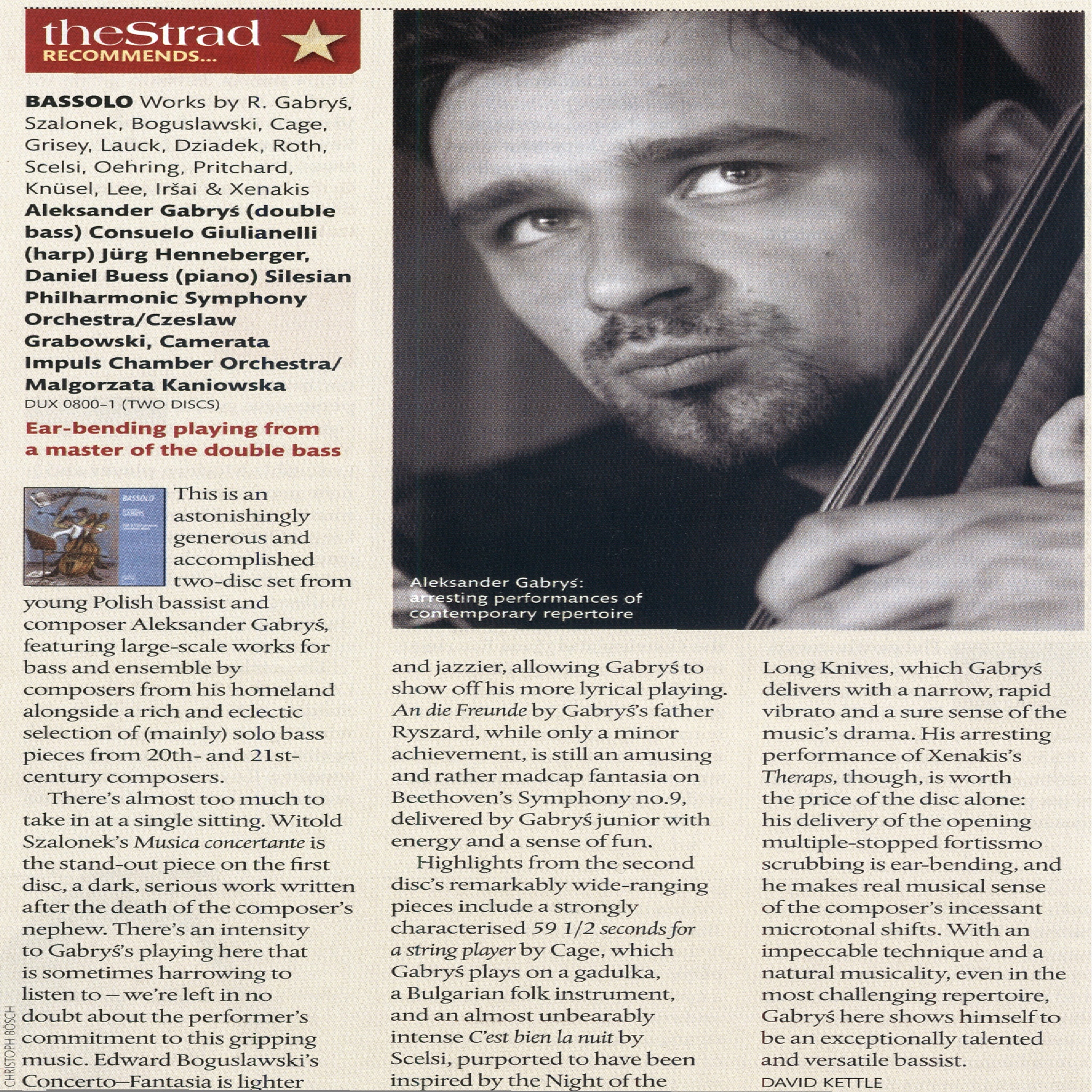
Aleksander Gabryś : des interprétations saisissantes du répertoire contemporain
C’est un coffret de deux CD étonnamment généreux et abouti du jeune contrebassiste et compositeur polonais Aleksander Gabryś, réunissant des œuvres de grande envergure pour contrebasse et ensemble dues à des compositeurs de son pays, aux côtés d’un choix riche et éclectique de pièces pour contrebasse, pour la plupart solistes, signées par des compositeurs des XXe et XXIe siècles.
Il y a presque trop de matière pour une seule écoute. Musica concertante de Witold Szalonek est la pièce marquante du premier disque : une œuvre sombre, grave, écrite après la mort du neveu du compositeur. Le jeu de Gabryś y possède une intensité parfois éprouvante à écouter — et l’engagement de l’interprète dans cette musique empoignante ne fait aucun doute. Le Concerto–Fantasia d’Edward Bogusławski est plus léger et plus jazzé, permettant à Gabryś de faire valoir son jeu le plus lyrique. An die Freude, de Ryszard, le père de Gabryś, bien que ce ne soit qu’une réussite mineure, n’en reste pas moins une fantaisie amusante et assez débridée sur la Symphonie no 9 de Beethoven, servie par Gabryś fils avec énergie et une évidente joie de jouer.
Parmi les moments forts d’un second disque d’une remarquable variété, figurent un 59 1/2 seconds for a string player de Cage au caractère très affirmé, que Gabryś joue sur une gadulka, instrument populaire bulgare, et un C’est bien la nuit de Scelsi presque insoutenable d’intensité, que l’on dit inspiré par la Nuit des longs couteaux, et que Gabryś interprète avec un vibrato serré et rapide ainsi qu’un sens sûr du drame musical. Mais son interprétation saisissante de Theraps de Xenakis justifie à elle seule le prix du disque : sa réalisation du frottement fortissimo initial, en cordes multiples, vous tord l’oreille, et il parvient à donner un véritable sens musical aux incessants déplacements microtonaux du compositeur. Par son impeccable technique et sa musicalité naturelle, jusque dans le répertoire le plus exigeant, Gabryś se révèle ici comme un contrebassiste exceptionnellement doué et polyvalent.
DAVID KETTLE