Work
Katábasis
KATÁBASIS is a descent beneath the surface of sound, the body and established roles. Its first public presentation in Wrocław started the work’s further crystallisation for Gods’ Games Garden Group.
Programme note
KATÁBASIS grows out of a need to look beneath the surface of sound and the body, and beneath one’s fixed self-image. It is a passage to the far bank: the performers who arrive are no longer the people who set out. Descending beneath one’s own bedrock — and one’s own DNA — reveals what still lives beneath habits, roles and learned patterns of action.
One of the work’s sources is an old European tale of Iron John, written down by the Brothers Grimm. In my reading, the boy’s encounter with the Wild Man sets him on a path towards maturity — one that requires him to leave a place of safety, lose his former standing and pass through the “zone of ashes”. Yet we do not illustrate the fairy tale. We carry its forces and symbols into the realm of sound, the body, listening and relationships between performers.
The descent is answered by emergence: singing from beneath the bedrock, a heart beating, knocking and being born anew. Agape binds them together — a turning towards people. KATÁBASIS is an encounter grounded in attentiveness, without appropriation: wildness, the grotesque and laughter coexist with focus and unease.
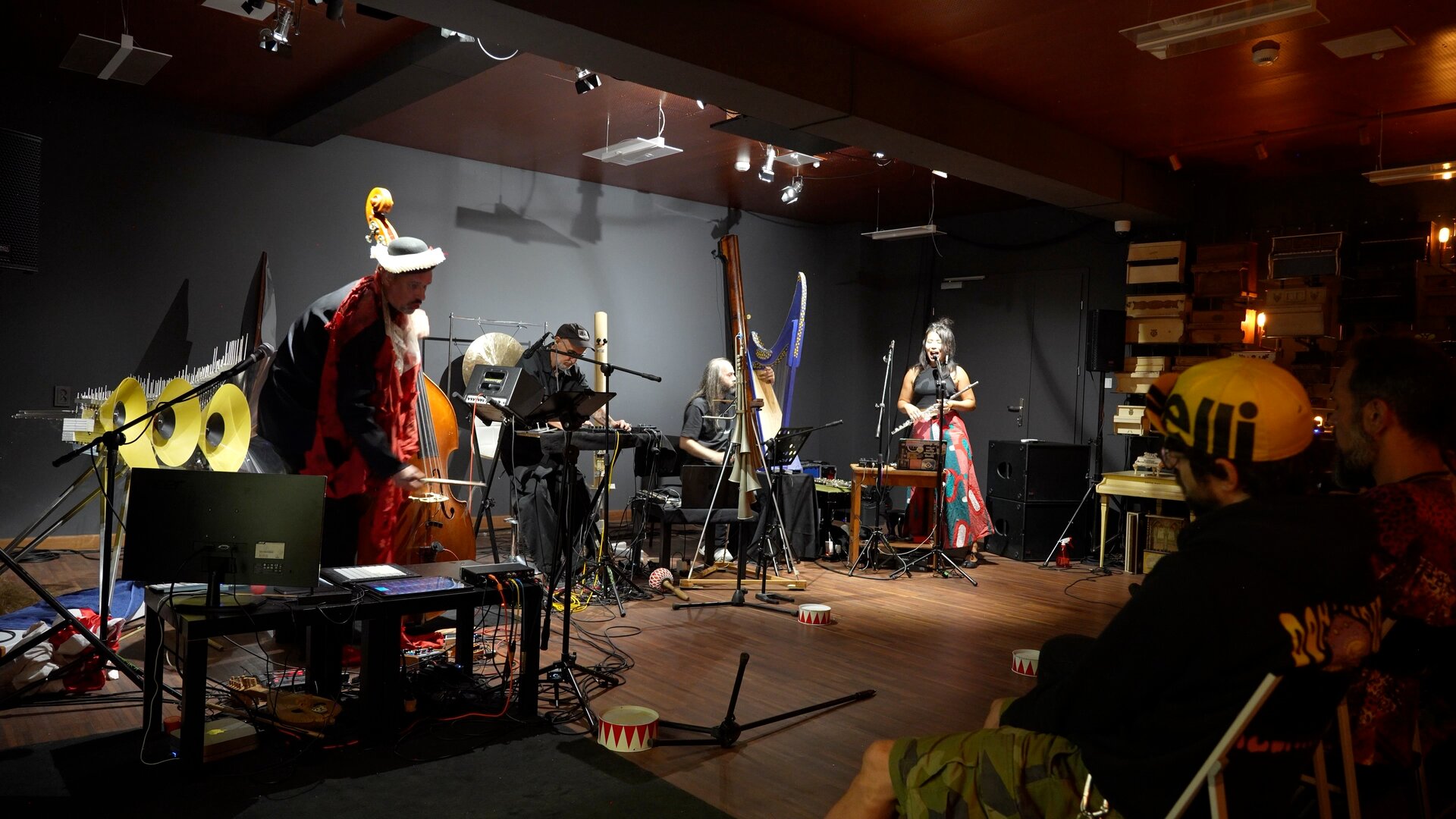
Paweł Romańczuk reveals himself here as Dionysus–Saint Paul–Mercury: he drives Dionysian transformation, is the patron of the Mad Instruments and, as Mercury the guide, leads us from one threshold to the next. His collection — comprising more than a thousand instruments and sound objects — opens up an almost boundless world of sounds in which he can endlessly change roles and his own stage identity.
Phoebe Bognár co-creates this crossing through the magnetic power of her sound and her vivid imagination — her ideas open new paths, while her artistic openness and human warmth give us the courage to follow them together.
Kostas Georgakopulos — our katápunk frontman — leads us with his voice and the gesture of “self-censorship” — the face-palm — through the zone of ashes.
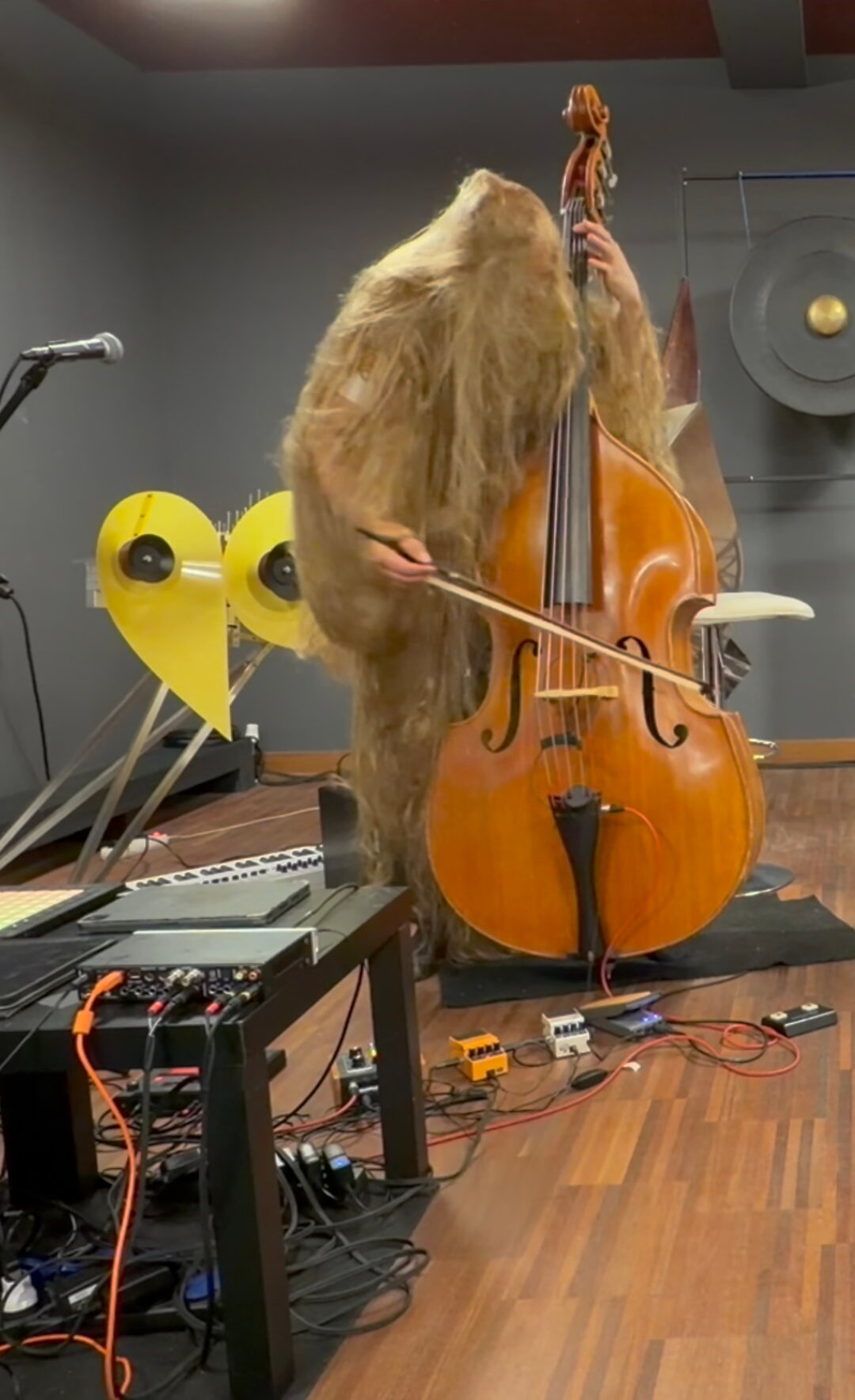
Voice transforms into an instrument, a gesture is taken over by another person, and sound returns as a memory of electronic transformations. The double bass remains at the centre: it drags us through layer after layer of descent, even as those layers act upon it. The musicians change places, roles and masks; gradually, it becomes less and less obvious whose voice it is, who is imitating whom, and where the boundary between human, instrument and machine runs.
KATÁBASIS belongs to Gods’ Games Garden — an open world where I have always found room for each new work. The Garden embodies SynARThesis: my concept of a synthesis of the arts, ways of feeling and fields of perception. One can co-create it, or simply enter, be and listen.
The Polish word “igry” — “igier” in the Garden’s name — leads us towards discovery through games and play. Roger Caillois distinguished four elements of play: competition, chance, imitation and vertigo — agon, alea, mimicry and ilinx. I had already drawn on the last of these in my 2017 work ILINX. In KATÁBASIS I descend deeper into this Thought — indeed, geo-logically: I bring Caillois’s account of games together with his reading of stones and minerals.
Within this authorial geo-logic, minerals reveal their own play — Nature’s Games. Agon plays out wherever growing crystals meet, limit one another and fight for space. Alea is at work in random admixtures, veins, colours and fracture paths. Mimicry makes a stone — without intention and without an author — take on the likeness of a landscape, map, plant, animal or face. Ilinx manifests itself in pressure, erosion, disintegration and metamorphosis, which deprive matter of its former equilibrium and usher it into a new order. Our human games turn out to be a response to games far older than we are, inscribed in matter itself.
The first public presentation of KATÁBASIS took place on 6 September 2026 at Galeria Toy Piano in Wrocław, as part of the Avant Art Festival. Phoebe Bognár, Paweł Romańczuk, Kostas Georgakopulos and I performed it amid Paweł’s extraordinary instrumentarium.
It was intended above all as a rehearsal and an encounter. All of a sudden, it became a concert before a full house. Wrocław showed me that the idea itself can draw people in and transform them even in its first, open and spontaneous form. The idea of KATÁBASIS awakened in us, as musicians, the need to explore what is “impossible”, “forbidden” and inaccessible in other concert settings.
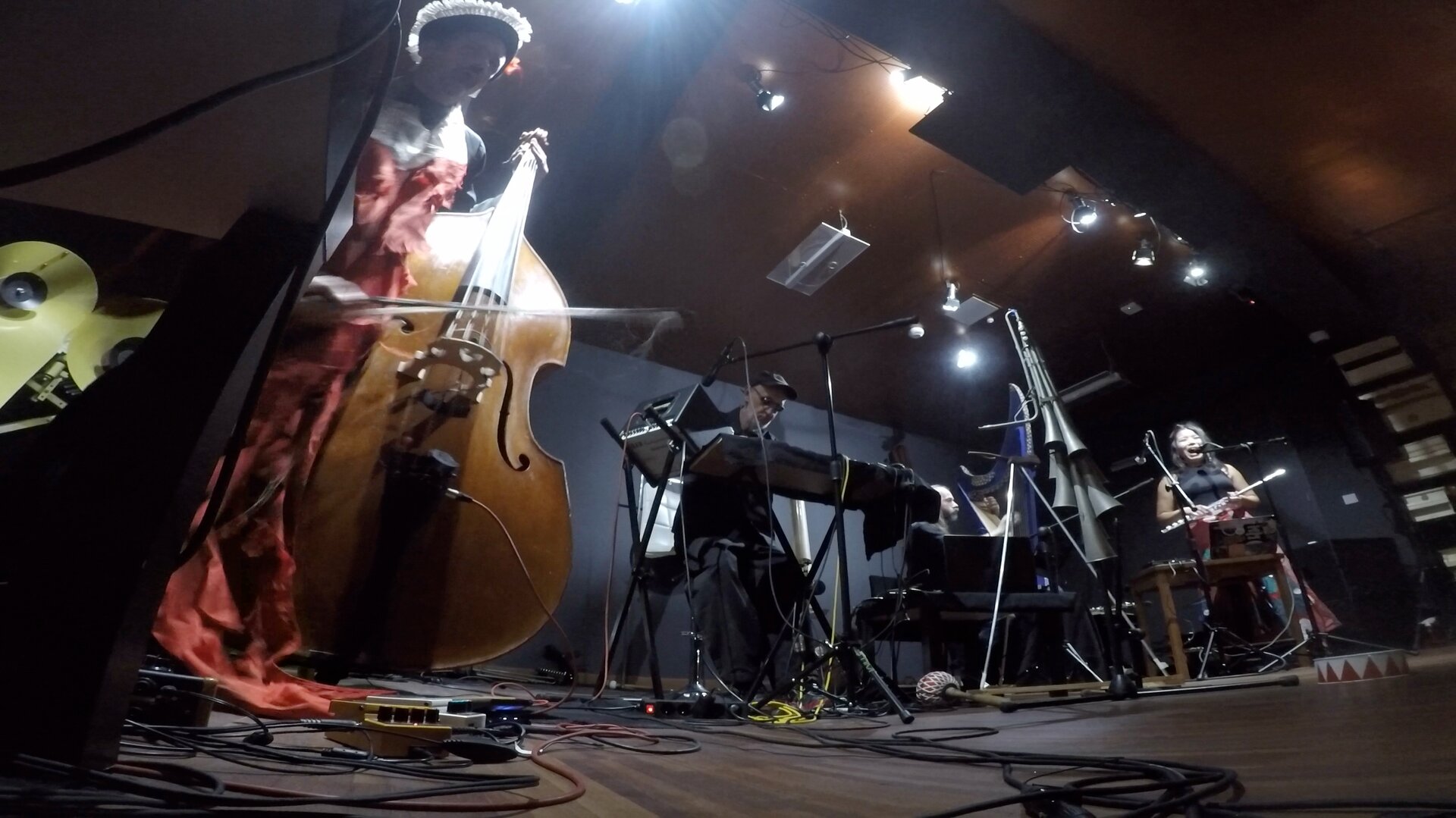
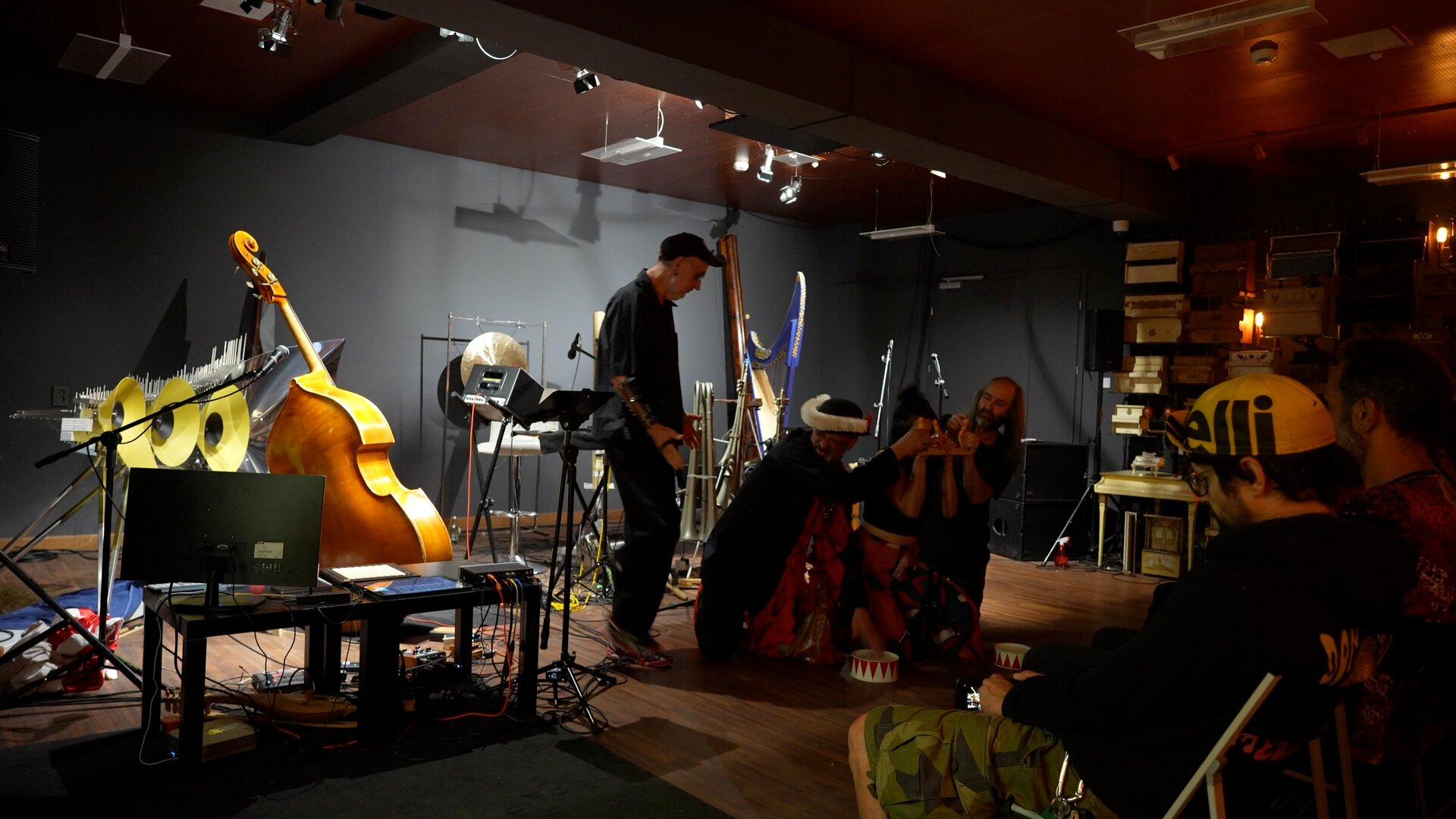
The Wrocław presentation did not bring the form to a close; it started its further crystallisation. From that experience, one of my forthcoming works is gradually emerging: KATÁBASIS for GGGG — Gods’ Games Garden Group, the Orchestra of Mad Instruments — with a flute part being written for Phoebe Bognár and the double bass in the leading role.
No previous performance has brought me so close to feeling that we can take control of our planet’s gravity. Perhaps this is precisely where the paradox of KATÁBASIS lies: descending ever deeper together, we discover the possibility of breaking free of the earth.