Text
Swiss Bestiarium and Other Works
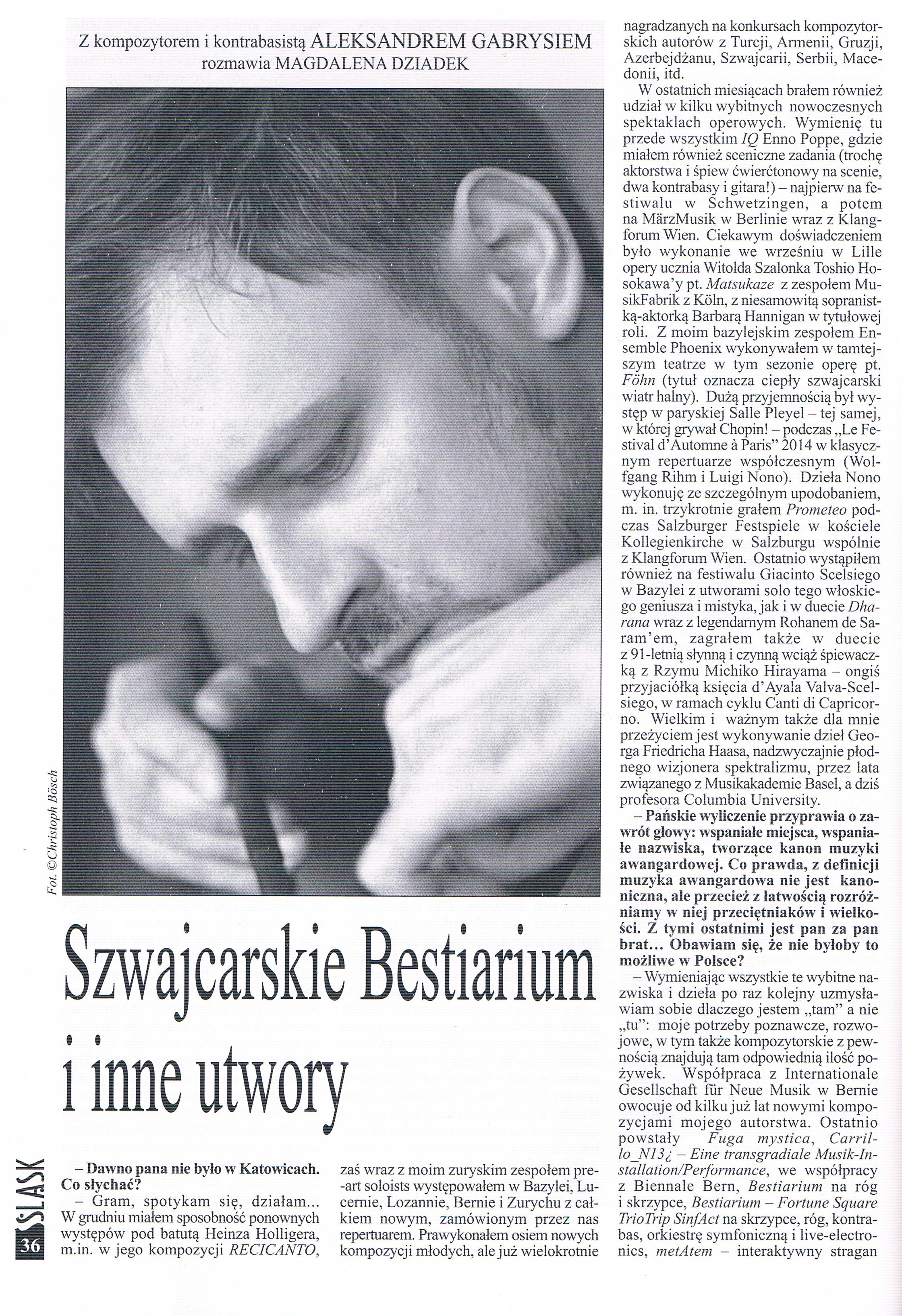
Magdalena Dziadek’s interview with Aleksander Gabryś, published in Śląsk in February 2015. The conversation covers the Swiss contemporary music scene, the works Bestiarium, Carrillo_N13 and metAtem, ensemble work, and the double bass in new music.
The collaboration with the Internationale Gesellschaft für Neue Musik in Bern has for several years now borne fruit in new compositions of mine.
It truly is a dream terrain for someone who wants to share atypical projects with the public, projects requiring, for example, a move into the open air, outside the concert hall.
It was an interactive musical spectacle lasting nonstop for 169 hours, 13 times 13, that is, one week and one hour.
This is proof that the solo double bass attracts contemporary creators, above all through the massiveness of its vibration in all registers, and also as a harmonic instrument: it often has a leading role in the ensemble.
Polish transcription based on the PDF file “Gabryś-wywiad - uzupelnienia 1.0 2.pdf”; publication metadata added from Śląsk, no. 2 (231), February 2015, pp. 36–37.
Śląsk, no. 2 (231), February 2015 — page 36
Full interview
MAGDALENA DZIADEK: It has been a long time since we saw you in Katowice. What is new?
ALEKSANDER GABRYŚ: I play, I meet people, I keep active... In December I had the opportunity to appear again under Heinz Holliger’s baton, among other things in his composition RECICANTO, while with my Zurich ensemble pre-art soloists I performed in Basel, Lucerne, Lausanne, Bern and Zurich with a completely new repertoire commissioned by us. I gave the world premieres of eight new compositions by young composers who have already been awarded many times in composition competitions, from Turkey, Armenia, Georgia, Azerbaijan, Switzerland, Serbia, Macedonia, and so on.
In recent months I have also taken part in several outstanding contemporary opera productions. I would mention above all Enno Poppe’s IQ, where I also had stage tasks (a bit of acting and quarter-tone singing on stage, two double basses and guitar!) - first at the festival in Schwetzingen, and then at MärzMusik in Berlin with Klangforum Wien. An interesting experience was the performance in September in Lille of Matsukaze, the opera by Toshio Hosokawa, a pupil of Witold Szalonek, with MusikFabrik from Cologne and the extraordinary soprano-actress Barbara Hannigan in the title role. With my Basel ensemble, Ensemble Phoenix, I performed the opera Föhn in the local theatre this season (the title means a warm Swiss mountain wind). It was a great pleasure to appear at the Salle Pleyel in Paris - the same hall where Chopin used to play! - during Le Festival d’Automne à Paris 2014, in classic contemporary repertoire (Wolfgang Rihm and Luigi Nono). I perform Nono’s works with particular fondness; among other things, I played Prometeo three times during the Salzburger Festspiele in the Kollegienkirche in Salzburg together with Klangforum Wien. Recently I also appeared at the Giacinto Scelsi festival in Basel with solo works by this Italian genius and mystic, as well as in the duo Dharana with the legendary Rohan de Saram; I also played in duo with the famous 91-year-old singer from Rome, Michiko Hirayama, still active today and once a friend of Prince d’Ayala Valva-Scelsi, as part of the cycle Canti di Capricorno. Performing the works of Georg Friedrich Haas, an extraordinarily prolific visionary of spectralism, for years associated with the Musikakademie Basel and today a professor at Columbia University, is also a great and important experience for me.
MAGDALENA DZIADEK: Your enumeration makes one dizzy: magnificent places, magnificent names, forming the canon of avant-garde music. True, by definition avant-garde music is not canonical, but still we easily distinguish in it between the average and the great. With the latter you are on familiar terms... I fear this would not have been possible in Poland?
ALEKSANDER GABRYŚ: Listing all these outstanding names and works, I realize once again why I am "there" and not "here": my cognitive and developmental needs, including compositional ones, certainly find there an adequate amount of nourishment. The collaboration with the Internationale Gesellschaft für Neue Musik in Bern has for several years now borne fruit in new compositions of mine. Recently there have been Fuga mystica, Carrillo_N13¿ - Eine transgradiale Musik-Installation/Performance, in collaboration with the Biennale Bern, Bestiarium for horn and violin, Bestiarium - Fortune Square TrioTrip SinfAct for violin, horn, double bass, symphony orchestra and live electronics, metAtem - an interactive sound stall after Dante Alighieri and Robert Walser’s Micrograms, an open-air musical action for four performers, self-playing instruments, double bass, lupophone and electronics, performed by us in Bern and Basel - these are some of the trails that link me with the capital of Switzerland.
MAGDALENA DZIADEK: What is a "lupophone"?
ALEKSANDER GABRYŚ: It is a bass oboe. The oboe, like the bassoon, is today experiencing a renaissance of new inventions in the form of its successors: the lupophone and the contraforte. These are marvels of technology, with an extraordinarily clear, strong and rich sound, the result of the experience and conclusions of brilliant builders who created this complex mechanism only a few years ago. What is missing is only the literature for these new instruments; we are therefore witnessing the birth of a new chapter in the history of music.
MAGDALENA DZIADEK: I imagine the compositions you have mentioned did not end up in a drawer?
ALEKSANDER GABRYŚ: Fortunately not, and this is another reason why I became so taken with Switzerland: it truly is a dream terrain for someone who wants to share with the public atypical projects, requiring, for example, a move into the open air, outside the concert hall. Last year I had two premieres: Walser Code - Scenario for Violin-Player and a three-hour interactive musical action on open squares in the heart of Bern and Basel, entitled metAtem. A few months earlier there had also been the premiere, and then several performances (in Czechia and Switzerland), of the largest of my works in terms of forces: BESTIARIUM Fortune Square TrioTrip SinfAct for three soloists, symphony orchestra and electronics. This work, in which we conduct various experiments with the processing of sound and live recordings, and test on stage instruments constructed by our own hands, is a version of an earlier duo for violin, horn, voices and portable electronics, which was performed in Lucerne, Katowice, Bytom, Brussels, London, Budapest, Novi Sad, Berlin and numerous Swiss cities.
MAGDALENA DZIADEK: Moving in the field of multimedia creation, you necessarily work in an ensemble, dividing the roles of composer and performer - if one can speak here at all of "divisibility"...
ALEKSANDER GABRYŚ: Of course, the principle here is communication, work with the team. As far as this circle of my activities is concerned, the multimedia actions Carrillo_N13¿ brought me a great deal of satisfaction; they were co-created in a quintet with an inventor, a director and two musicians, plus two engineers and the backing of the Biennale Bern festival. In six weeks, in a spacious attic in the centre of the capital, we built a musical machine with a frame made of five tons of wood and an inflated aeronautical balloon "blown" into it, through whose "airlock" the public could enter to reach us. It was an interactive musical spectacle lasting nonstop for 169 hours, 13 times 13, that is, one week and one hour. We had our own rhythm of action, our own language, a loge in the middle of the stage, and we referred to the ideas of the microtonal music of Julián Carrillo and Ivan Wyschnegradsky.
Another mode of new communication with the public was the "musical stall", with instruments we had built ourselves, inviting the public to enter, through sound, into the structure of our unceasing sonority. Like laboratory workers, we introduced a chance public into our exhibition of sounding objects on Münsterplatz in Bern and Theodorskirchplatz in Basel. In addition to the instruments and the dramatic plan of the action, I also prepared a three-hour soundtrack that led us through the action of Dante’s Divine Comedy as seen musically. Video material documenting these activities will soon appear online.
MAGDALENA DZIADEK: You left Poland as a beginning composer and a mature double-bass soloist. Are you still faithful to your instrument?
ALEKSANDER GABRYŚ: Of course. Recently I have had quite a number of solo tasks, for example the performance of Iannis Xenakis’s extremely difficult THERAPS as part of a portrait concert devoted to that composer, at the invitation of Ensemble Modern from Frankfurt am Main, in the great hall of WDR Radio in Cologne, and also at the invitation of the IGNM in Bern. I also made, with a rotating camera, a recording of the music accompanying a silent video recording of a conductor’s performance, as part of Jannik Giger’s project Gabrys und Henneberger - Transformation. I also often perform works written especially with me as a double bassist in mind, for example in ensemble projects by Thomas Kessler (with Collegium Novum Zürich - there I play high harmonic multiphonics, special vibrations), Junghae Lee, Michel Roth, Alfred Knüsel, Helmut Oehring and many others. This is proof that the solo double bass attracts contemporary creators, above all through the massiveness of its vibration in all registers, and also as a harmonic instrument: it often has a leading role in the ensemble. This is what happens in works written for years for pre-art soloists. I sat on the jury of the composition competition organized by that ensemble. From its participants we received many original and independent proposals, fresh ideas for music with a "punchy" role for the double bass. Every year, through the competitions, we receive an injection of new compositional energy from the East - from countries outside the EU; we have also made several concert tours to those regions: Armenia, Azerbaijan, Georgia, as well as the entire Balkans, from Slovenia, Croatia, Serbia, Bosnia and Herzegovina to Montenegro and Macedonia. These journeys constitute a mutual exchange of good creative energy: local people are extraordinarily happy to host our ensemble.
MAGDALENA DZIADEK: I would like you, in conclusion, to describe briefly for us the cultural side of Basel. Are Poles visible there?
ALEKSANDER GABRYŚ: Basel, a place extraordinarily rich in culture, means collections of old and new art, admired by collectors and famous, for example, through its art fair ART BASEL, which every year draws to the city the most distinguished and most expensive galleries from all over the world. Besides, even in everyday life it is almost impossible to take in the offerings and exhibitions in galleries, foundations, musical stages, theatres, museums and independent venues: these are inexhaustible storehouses of art, for example the Paul Sacher Stiftung, in whose concert series I will perform in April, the Fondation Beyeler, the activities of the Schaulager, the projects of the Kunsthalle, the Haus der Elektronischen Künste, Gare du Nord - Bahnhof für Neue Musik, Imprimerie Basel, Theater Basel, the underground groups KLAPPFON and PLATTFON, or the Music Academy itself, a powerful driving engine of the city’s culture. The music festivals pulse very distinctly; Festival Rümlingen is important - a kind of "pre-festival", discovering the "diamonds" of future culture, compositional names still unknown but which will be prominent in five to ten years on the world’s greatest stages. Here the role of the Warsaw-born Sylwia Żytyńska is significant: percussionist, performer, improviser, composer and teacher, she has for more than two decades set the tone for many innovative artistic activities in Switzerland. She not only creates and educates herself, but also produces excellent "pro musica nova" series, for example the cycle addressed to children, Gare des Enfants. In a melting pot as powerful and dense with cultural contents as Basel - a city binding together three neighbouring countries, whose symbol is the nearby Basel-Mulhouse-Freiburg airport, the only trinational airport in the world - it is difficult to speak of any distinctive place for Polish musical culture. It is a component of the global accumulation of creators to whom ethnologists have today given the apt name "transnational".
It is perhaps not immodest to assign myself a place in that broad current: the CD Robert Walser in der schweizer Musik, which includes my work Da ich ein Knabe war, remains a testimony to this, as does a series of premieres of my music that have taken place in Switzerland. Several times I have given interviews for local radio and television; all this probably testifies to the openness of the Swiss and their receptiveness to innovative trends, to their careful picking up of cultural stimuli flowing from everywhere, including from Poland. It was in Basel that I had the opportunity to meet Zbigniew Karkowski, whom I had admired from afar for years; it was precisely there that I had the occasion to premiere his work, to become friends with him and to receive a work-dedication for solo double bass and electronics. This understanding lasted and bore fruit until the end of the life of this outstanding "creator apart", resident in Tokyo, pupil of Xenakis, who visited Katowice and my home shortly before his death.
I will add only in passing that several times I have had a share in the "export" of Swiss musicians to Poland, to Katowice, Krakow and Warsaw, in collaboration, among others, with the Pro Helvetia Foundation. The cream of Swiss musicians played here the music of their country, as well as German music and my works.
MAGDALENA DZIADEK: Thank you for the conversation.