Text
Bazyli Matysiak (1929–1992)
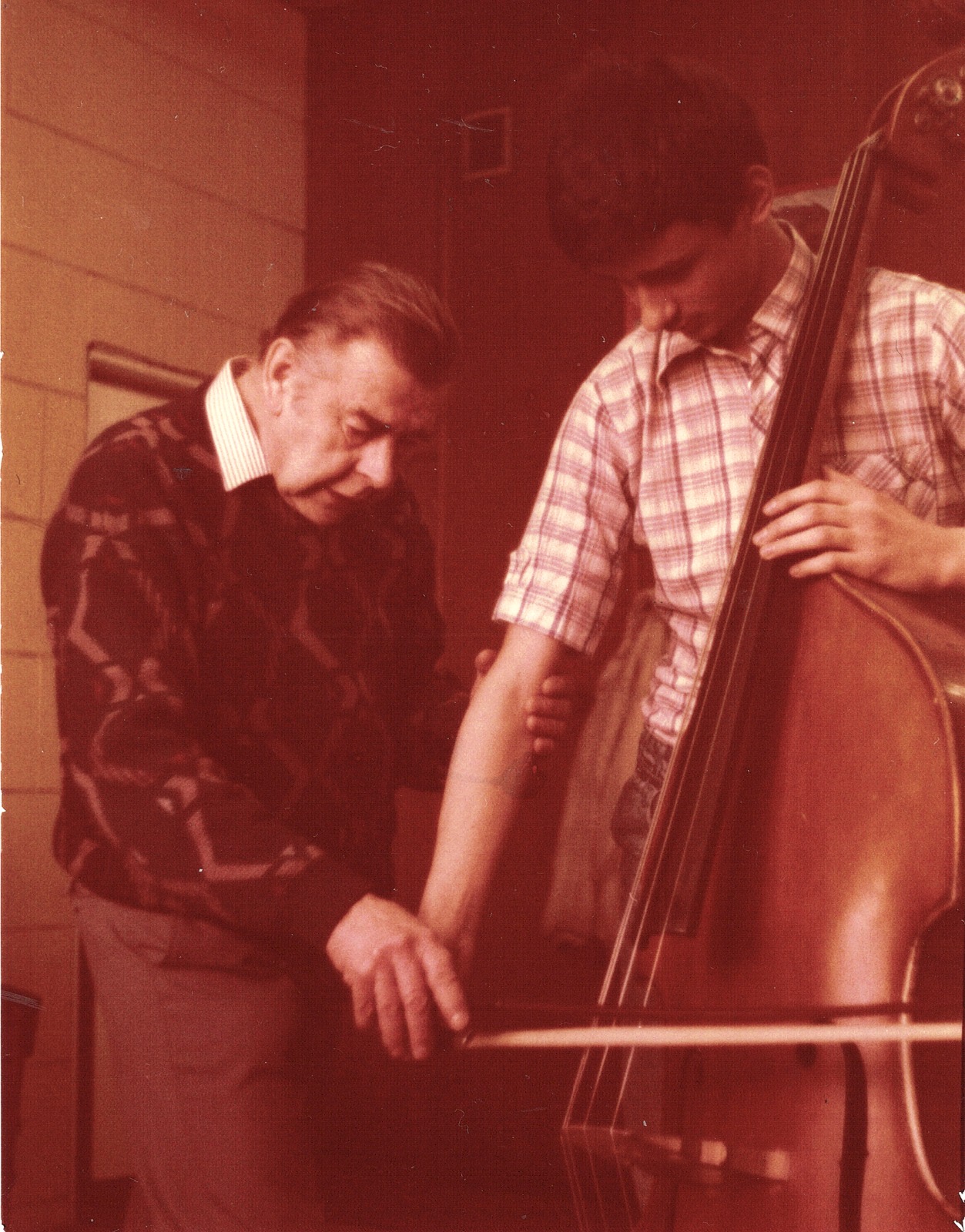
Aleksander Gabryś’s personal remembrance of Bazyli Matysiak, his first double bass professor: a teacher who knew how to see people and open the world of sound before them.
Bazyli Matysiak (1929–1992)
I do not remember the first lesson.
I remember the way there.
To reach the double bass room, no. 418, on the fourth and topmost floor of "Karłowicz", the music school named after Mieczysław Karłowicz, you first had to pass through a narrow, dark corridor. On the way you passed the violin room. From morning until evening, practice there never stopped - dozens of bows slicing through the air. This had one unexpected advantage. When, a moment later, I opened the door to the double bass room, every sound of the instrument seemed like deliverance. It hardly mattered what you played. The sound itself was enough.
Then came the double doors — almost like passing through a theatrical airlock. For a fraction of a second, an almost theatrical darkness would fall. And then, at once, there was light, the smell of old wood, scores, rosin, and dry bow hair.
And a voice.
— Prego, Maestro! Avanti! Aleksander Gabryś! Polska!
That was how Bazyli Matysiak greeted me.
I was thirteen.
Looking back, I think it was then, exactly then, that I first felt what it means to be truly seen by a teacher. Not because I had played well. Not because I was gifted. Simply because someone was glad that I was there.
That was how one of the most important relationships of my life began.
⸻
Professor Matysiak was a member of the Great Symphony Orchestra of Polish Radio and Television. For me, above all else, he was a human being.
He had a touch of Yogi Bear about him - the warmth, the good nature - and at the same time the agility of a fox, the dexterity of a circus juggler, and the intuition of a wise clown. With a single joke he could change the way a person saw a situation that, only a moment earlier, had seemed painful or unjust. He never made anyone feel ashamed. He did not build authority on fear. He demanded a great deal, but he gave even more.
He had survived the war. He grew up in poverty, which he sometimes spoke of calmly, without a trace of bitterness. I think now that it was there he learned something extraordinary - that intelligent humor is one of the greatest gifts one human being can offer another.
He spoke softly. With a smile. He liked to slip unexpectedly into Italian.
Prego… Maestro… Amico…
It sounded so natural, as if music really were a shared language.
I once ran into him by chance in the market square in Katowice. He was standing there with a cigarette. When he saw me, he tucked it into his mouth, closed his lips, and after a moment let the smoke out... through his ears. He laughed like a boy. Only later did he tell me that he had learned the trick years before, when he worked in a circus.
To this day, whenever I think of it, it is not the cigarette I see, but his childlike joy in making people laugh.
⸻
The greatest gift I received from him was not that he taught me how to play the double bass.
He gave his warmth to both of us: to me and to the double bass.
From the very first lessons, I never felt I was holding a thing in my hands. Everything was alive. Sound. Movement. Wood. The smell of bow hair warmed by friction, of rosin and metal strings. Perhaps there was also something in it of that Silesian work ethic that the Professor carried within him all his life.
That same day, after the first lesson, I was allowed to use the school double bass in the evenings. I immediately began inventing sounds of my own.
Glissandi.
Rough sounds behind the bridge.
Sounds on the tuning pegs.
On the fingerboard.
On the endpin.
A finger drawn slowly along the G string, hidden harmonics beginning to flicker into life - like stars appearing in the sky one after another.
That was when I understood that the double bass could sing everywhere.
That it is a little like electronic music.
Only without a computer.
I returned home entirely convinced that from two school double basses one could build a single, even better one. Fortunately, my parents put a stop to my first instrument-building ideas in time.
But it was already too late.
Suddenly, the world seemed much larger.
⸻
The most beautiful time of all was the summer holidays.
For most children, when school closes for the summer, freedom begins.
For me, from the moment I began playing the double bass, it would have meant loss.
I pleaded for permission to be one of that handful of pupils allowed to come to the empty building in summer and practice.
I still remember that room.
Warm from the summer sun.
In the slanting light that entered from the right, dust motes and white rosin powder drifted.
It smelled of wood.
Of scores.
Of rosin.
It was a silence that was not empty.
It was full of music still waiting to happen.
And often, just then, the telephone would ring.
The Professor would be back from Japan or from Italy.
— Aleksander... shall we meet?
I cannot describe the joy I felt after such calls.
I would run to school with my head full of new discoveries and experiments. He always listened to it all with genuine curiosity.
And from his travels he brought back little things.
Rosin.
A picture.
Some little souvenir.
I still have the green Petz rosin he gave me then.
Sometimes I open the box only to smell that scent once more.
⸻
After a few months of lessons, something happened that now seems extraordinary to me.
The Professor wrote a short etude for me.
He did not consider himself a composer.
He simply handed me a few pencilled staves and said it was a sketch I could develop further in my own way.
He could not have known that, with that simple gesture, he was opening before me the path I would follow for my entire life.
It was the first piece written especially for me.
And the first time someone told me that I could write what came next myself.
⸻
Once he hurt me deeply.
Or rather - that is how it felt to me then.
During a lesson he stopped me as I was playing and, with a slight, almost apologetic smile, told me not to "make a fool of him".
I hid in the school toilets and cried, I think, for half an hour.
I was convinced that I had disappointed a man I respected so deeply.
When I finally came out and went down to the ground floor, he was waiting for me.
He came over to me.
He apologized.
Now I know how much humility, empathy, and inner strength it takes for an adult to apologize to a thirteen-year-old pupil.
I think that on that day he taught me something far more important than how to play the double bass.
⸻
When, many years later, I showed the Professor my first prize-winning compositions - Miniatury na kontrabas i dźwięki komputerowe and Voak gefeustich - he was probably every bit as happy as I was.
Looking back now, I find myself thinking more and more often that Bazyli Matysiak's greatest talent was not teaching how to play.
It was seeing people.
Making them want to be braver.
More hardworking.
More themselves.
In the years since, I have met many great artists and teachers. Each of them has left some trace in me, and to each of them I am grateful for it.
But whenever I open the green box of Petz rosin, I return to the fourth floor of "Karłowicz".
I pass through the dark corridor.
I pass the violins.
I open the double doors.
Darkness falls for a moment.
And then I hear again:
— Prego, Maestro! Avanti! Aleksander Gabryś! Polska!
There are people the past tense cannot hold.
For me, Bazyli Matysiak is one of them.
If I had to say, in a single sentence, who my first double bass Professor was to me, I would simply say:
I would like to be like him.
⸻
Aleksander Gabryś
Basel, July 2026