Text
I Saw Eternity the Other Night
Interview published in the Polish magazine Twoja Muza in 2011. Topics include Bassolo, composition, performance practice, contemporary music, Poland and Switzerland.
I compose in my own style.
The boundary between art and life is consciously blurred and crossed by me.
It is more than 141 minutes of music performed rarely or never before.
The combination of these qualities [...] allowed me to “call forth” many new works with the double bass in the leading role.
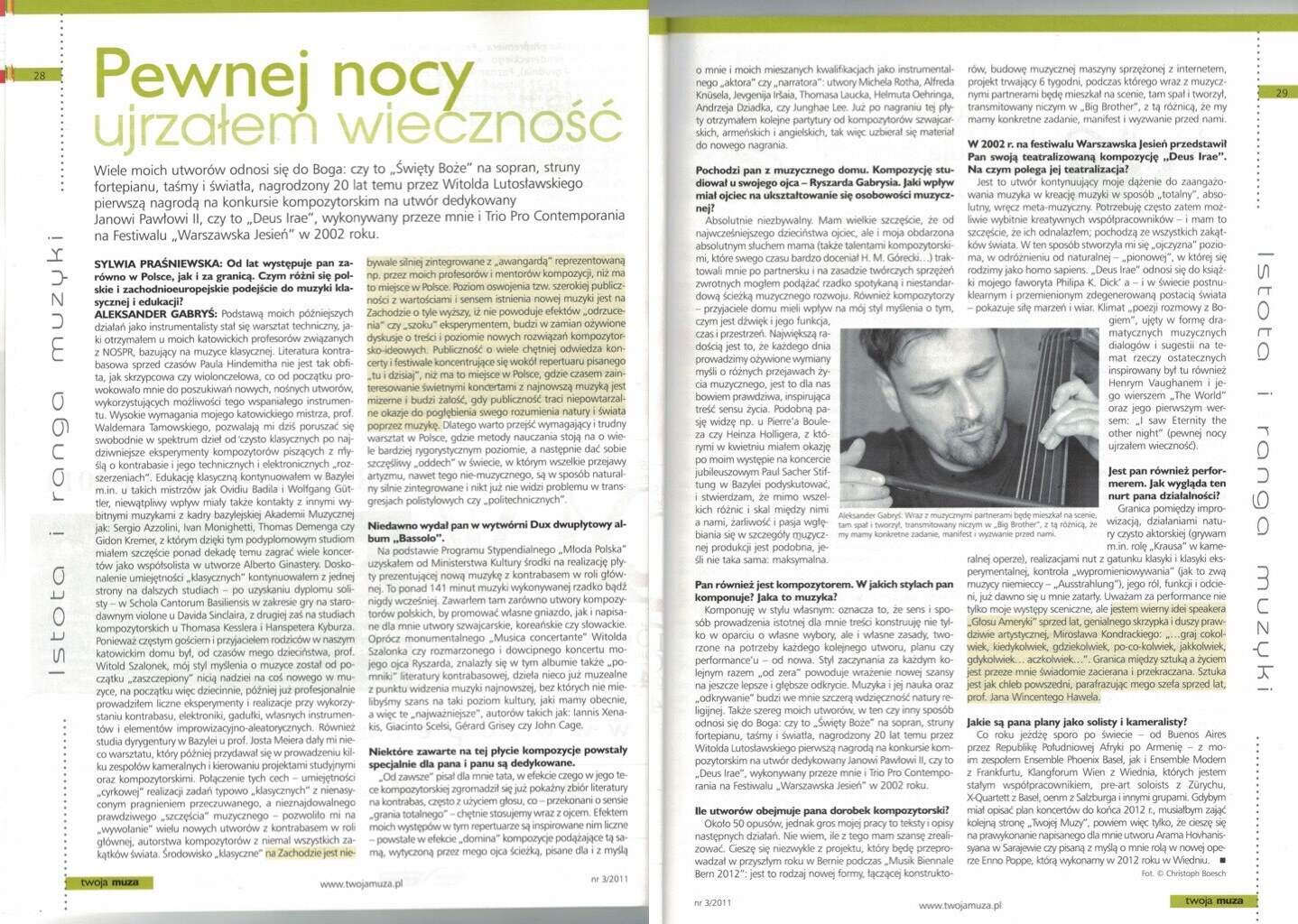
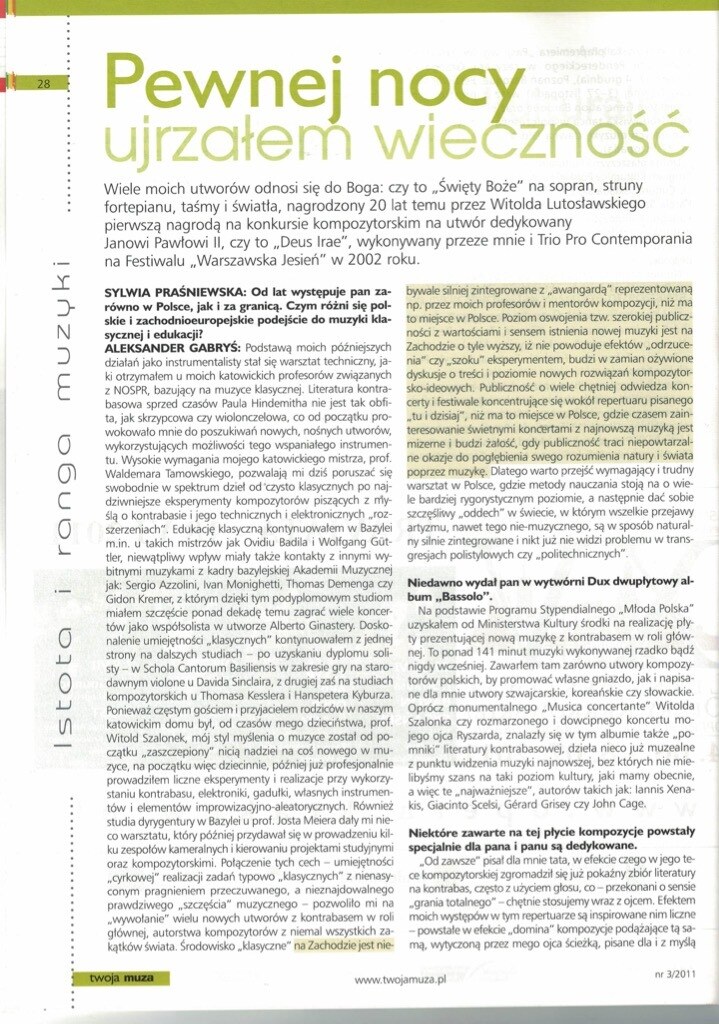
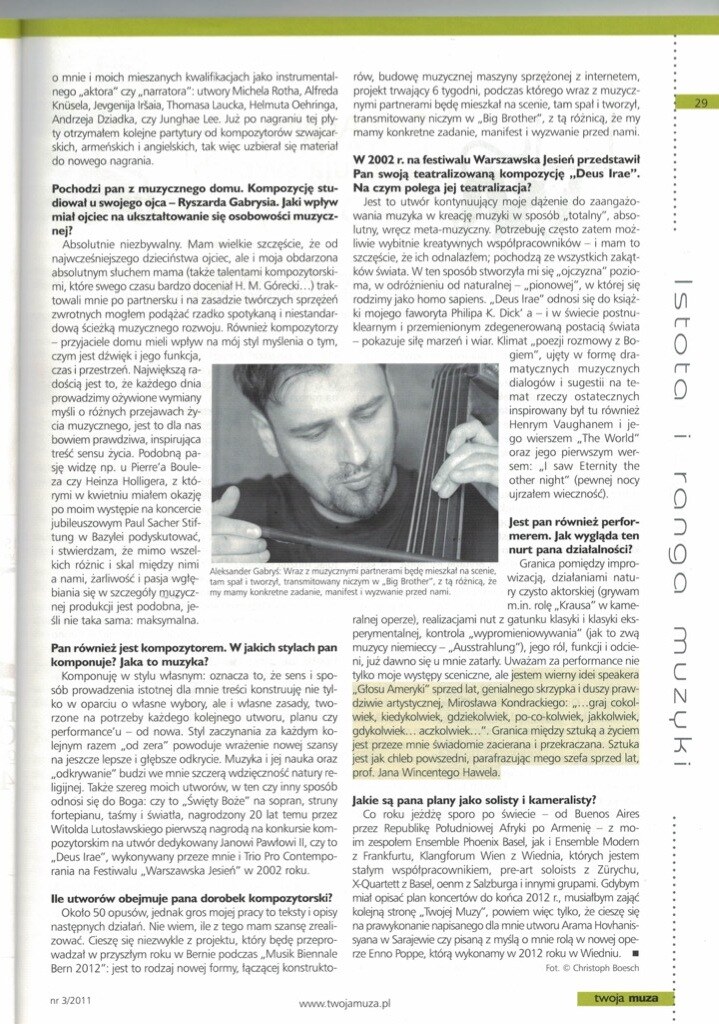
Original Polish transcription from Twoja Muza no. 3 (46), June-July 2011.
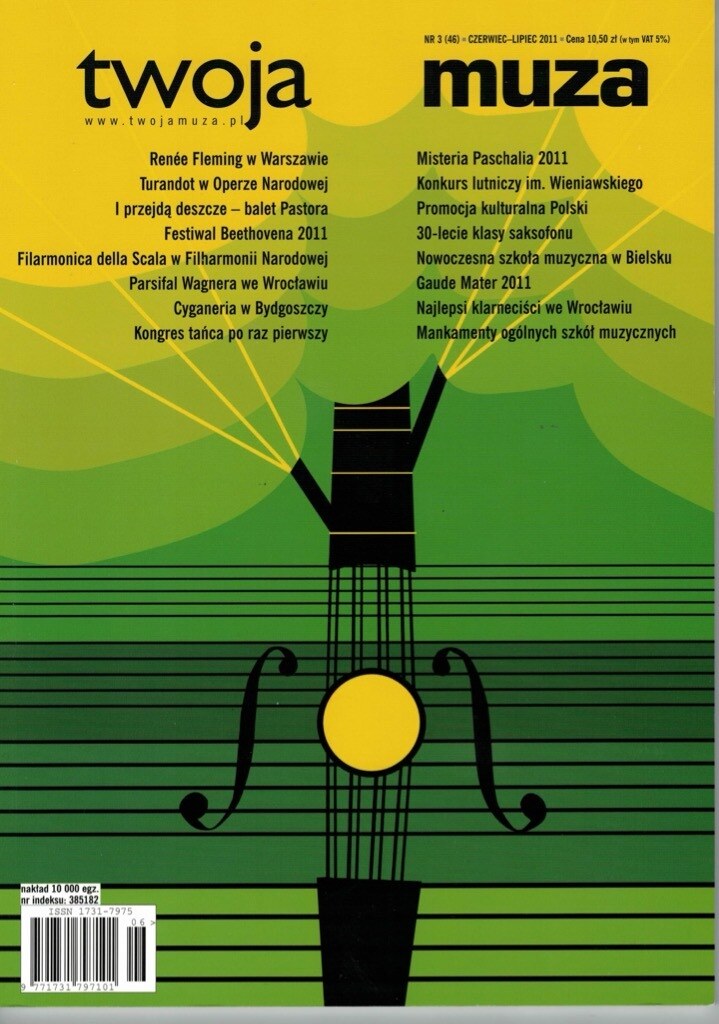
Twoja Muza, no. 3/2011 — cover
Full interview
Many of my works refer to God: whether “Święty Boże”, for soprano, piano strings, tapes and lights, awarded twenty years ago by Witold Lutosławski with first prize in the composition competition for a work dedicated to John Paul II, or “Deus Irae”, performed by me and Trio Pro Contemporania at the “Warsaw Autumn” Festival in 2002.
SYLWIA PRAŚNIEWSKA: For years you have performed both in Poland and abroad. How do the Polish and Western European approaches to classical music and education differ?
ALEKSANDER GABRYŚ: The basis of my later activities as an instrumentalist became the technical craft I received from my Katowice professors connected with NOSPR, based on classical music. The double bass literature before the time of Paul Hindemith is not as abundant as the violin or cello literature, which from the beginning provoked me to search for new, substantial works using the possibilities of this magnificent instrument. The high demands of my Katowice master, Prof. Waldemar Tamowski, allow me today to move freely in a spectrum of works from the “purely classical” to the strangest experiments of composers writing with the double bass in mind and with its technical and electronic “extensions”. I continued my classical education in Basel, among others with such masters as Ovidiu Badila and Wolfgang Güttler; contacts with other outstanding musicians from the faculty of the Basel Academy of Music also undoubtedly had an influence, such as Sergio Azzolini, Ivan Monighetti, Thomas Demenga or Gidon Kremer, with whom, thanks to these postgraduate studies, I had the good fortune more than a decade ago to play many concerts as co-soloist in a work by Alberto Ginastera.
I continued perfecting my “classical” skills, on the one hand in further studies - after obtaining the soloist diploma - at the Schola Cantorum Basiliensis in the field of the old violone with David Sinclair, and on the other in composition studies with Thomas Kessler and Hanspeter Kyburz. Because Prof. Witold Szalonek, from the time of my childhood, was a frequent guest and friend of my parents in our Katowice home, my style of thinking about music was from the beginning “inoculated” with a thread of hope for something new in music; at first, then, childishly, later already professionally, I carried out numerous experiments and realizations using the double bass, electronics, gadulka, my own instruments and improvisational-aleatoric elements.
Conducting studies in Basel with Prof. Jost Meier also gave me a certain craft, which later proved useful in leading several chamber ensembles and directing studio and composition projects. The combination of these qualities - the “circus” ability to carry out typically “classical” tasks with an insatiable desire for a true musical “happiness” sensed in advance, yet unfindable - allowed me to “call forth” many new works with the double bass in the leading role, by composers from almost every corner of the world.
The “classical” environment in the West is incomparably more strongly integrated with the “avant-garde”, represented for example by my composition professors and mentors, than is the case in Poland. The level of familiarization of the so-called broad public with the values and the sense of the existence of new music is higher in the West insofar as it does not cause effects of “rejection” or “shock” at experiment; instead, it awakens lively discussions about the content and level of new compositional and ideological solutions. The public visits concerts and festivals centered around repertoire written “here and today” much more willingly than is the case in Poland, where interest in excellent concerts of the newest music is sometimes miserable and arouses sadness, when the public loses unrepeatable opportunities to deepen its understanding of nature and the world through music. Therefore it is worth passing through the demanding and difficult training in Poland, where teaching methods stand at a much more rigorous level, and then giving oneself a fortunate “breath” in a world where all manifestations of artistry, even non-musical artistry, are naturally strongly integrated, and where no one any longer sees a problem in polystylistic or “polytechnical” transgressions.
You recently released the two-disc album “Bassolo” on the Dux label.
On the basis of the “Młoda Polska” Scholarship Programme, I received funds from the Ministry of Culture to realize a disc presenting new music with the double bass in the leading role. It is more than 141 minutes of music performed rarely or never before. I included there both works by Polish composers, in order to promote my own roots, and Swiss, Korean or Slovak works written for me. Apart from Witold Szalonek’s monumental “Musica concertante” or the dreamy and witty concerto of my father Ryszard, the album also contains “monuments” of the double bass literature, works already somewhat museum-like from the point of view of the newest music, without which we would have no chance of the level of culture we now have, and therefore those “most important” ones, by authors such as Iannis Xenakis, Giacinto Scelsi, Gérard Grisey or John Cage.
Some of the compositions included on this disc were written especially for you and are dedicated to you.
Dad has “always” written for me, as a result of which a considerable collection of literature for double bass has already accumulated in his composer’s portfolio, often with the use of voice, which - convinced of the sense of “total playing” - my father and I gladly use. The result of my performances in this repertoire are numerous compositions inspired by it - arising through a “domino” effect - following the same path laid out by my father, written for me and with me in mind, and with my mixed qualifications as an instrumental “actor” or “narrator”: works by Michel Roth, Alfred Knüsel, Jevgenij Iršai, Thomas Lauck, Helmut Oehring, Andrzej Dziadek or Junghae Lee. Already after recording this disc I received further scores from Swiss, Armenian and English composers, so material has gathered for a new recording.
You come from a musical home. You studied composition with your father, Ryszard Gabryś. What influence did your father have on the shaping of your musical personality?
Absolutely indispensable. I have great luck that from my earliest childhood my father, but also my mother, who is endowed with absolute pitch (and also compositional talents that H. M. Górecki in his time greatly appreciated...), treated me as a partner, and on the principle of creative feedback loops I could follow a rarely encountered and nonstandard path of musical development. The composers who were friends of the house also influenced my style of thinking about what sound and its function are, time and space. The greatest joy is that every day we conduct lively exchanges of thought about various manifestations of musical life, for this is for us the true, inspiring content of the meaning of life. I see a similar passion, for example, in Pierre Boulez or Heinz Holliger, with whom in April I had the opportunity, after my appearance at the jubilee concert of the Paul Sacher Stiftung in Basel, to talk, and I find that despite all differences and scales between them and us, the ardor and passion for entering into the details of musical production is similar, if not the same: maximal.
You are also a composer. In what styles do you compose? What kind of music is it?
I compose in my own style: this means that I construct the meaning and the manner of leading the content essential to me not only on the basis of my own choices, but also on my own principles, created anew for the needs of each successive work, plan or performance. The style of beginning each successive time “from zero” creates the impression of a new chance for an even better and deeper discovery. Music and its study and “discovery” awaken in me a sincere gratitude of a religious nature. A number of my works, too, in one way or another refer to God: whether “Święty Boże”, for soprano, piano strings, tapes and lights, awarded twenty years ago by Witold Lutosławski with first prize in the composition competition for a work dedicated to John Paul II, or “Deus Irae”, performed by me and Trio Pro Contemporania at the “Warsaw Autumn” Festival in 2002.
How many works does your compositional output comprise?
About fifty opuses; however, the bulk of my work is texts and descriptions of next actions. I do not know how much of this I have a chance to realize. I am extremely pleased about the project that I will carry out next year in Bern during the “Musik Biennale Bern 2012”: it is a kind of new form, joining constructors, the building of a musical machine coupled with the Internet, a project lasting six weeks during which, together with musical partners, I will live on stage, sleep there and create there, transmitted as in “Big Brother”, with the difference that we have a concrete task, a manifesto and a challenge before us.
In 2002, at the Warsaw Autumn festival, you presented your theatricalized composition “Deus Irae”. What does its theatricalization consist in?
It is a work continuing my striving to engage the musician in the creation of music in a “total”, absolute, even meta-musical way. I therefore often need collaborators as exceptionally creative as possible - and I have the good fortune that I have found them; they come from all corners of the world. In this way a horizontal “homeland” has formed for me, as distinct from the natural one - “vertical” - in which we are born as homo sapiens. “Deus Irae” refers to a book by my favorite, Philip K. Dick - and in a postnuclear world transformed into a degenerated form of the world - it shows the strength of dreams and beliefs. The atmosphere of “the poetry of conversation with God”, cast in the form of dramatic musical dialogues and suggestions concerning final things, was here also inspired by Henry Vaughan and his poem “The World” and by its first line: “I saw Eternity the other night”.
You are also a performer. What does this current of your activity look like?
The boundary between improvisation, actions of a purely acting nature (I play, among other things, the role of “Kraus” in a chamber opera), realizations of notes from the genre of the classics and experimental classics, the control of “radiating” (as German musicians call it - “Ausstrahlung”), its roles, functions and shades, has long since blurred for me. I consider as performance not only my stage appearances, but I remain faithful to the idea of a speaker of the “Voice of America” from years ago, a brilliant violinist and a truly artistic soul, Mirosław Kondracki: “...play whatever, whenever, wherever, for-whatever, however, although...”. The boundary between art and life is consciously blurred and crossed by me. Art is like daily bread, to paraphrase my boss from years ago, Prof. Jan Wincenty Hawel.
What are your plans as a soloist and chamber musician?
Every year I travel quite a lot around the world - from Buenos Aires through the Republic of South Africa to Armenia - with my ensemble, Ensemble Phoenix Basel, as well as with Ensemble Modern from Frankfurt, Klangforum Wien from Vienna, with whom I am a regular collaborator, the pre-art soloists from Zurich, XQuartett from Basel, oenm from Salzburg and other groups. If I were to describe the concert plan until the end of 2012, I would have to take up another page of “Twoja Muza”, so I will only say that I am looking forward to the premiere in Sarajevo of the work written for me by Aram Hovhannisyan, or to the role being written with me in mind in the new opera by Enno Poppe, which we will perform in 2012 in Vienna.