Work
Aleksandrietta
The gadułka turned my double-bass world upside down.
Related media
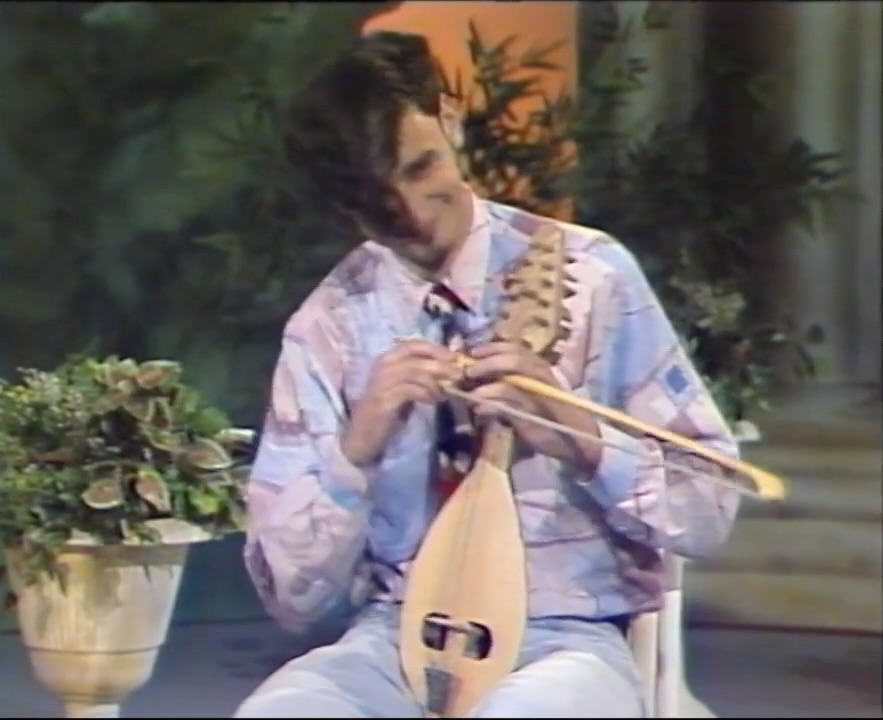
Aleksander Gabryś with a gadułka.
Programme note
During my performances in Bulgaria in the 990s of the previous millennium, I bought a gadułka in Varna together with an accordion method book.
Inside that modest accordion method book I discovered an extraordinary palette of Bulgarian melodies and rhythms organised around metres progressing from 2/8 all the way to 23/16.
For my ear and the string of my soul, it became an elixir distilled from the musical spices of India and Europe.
What fascinated me most was the extraordinary density of that musical thinking — saturated with history, culture and folklore, yet governed by a rhythmic logic I had never encountered before.
I was equally moved by the devotion to this music that I witnessed among Bulgarian musicians and experienced while spending time with them.
With the gadułka in my hands, I decided that I, too, wanted to become a flower of that living plant — perhaps only in a slightly different colour and timbre.
The instrument itself proved an even greater discovery. On the double bass, the string is pressed from above with the fingertip. On the gadułka, one touches it from below or from the side with the fingernail. This was not merely a different performing technique. It was an entirely different philosophy of contact with sound.
European vibrato oscillates around a single point. Gadułka vibrato is a continuous glissando — a movement back and forth, higher and lower, wider and narrower, faster and slower. It resembles a snake's dance more than the trembling of a single tone. I associated it with Arabic music, and later also with the Indian sarangi tradition. For the first time I felt that the mere act of touching a string could completely change the way one hears music.
For many months I practised Bulgarian folklore; later, in parallel, I also performed John Cage's 59½ Seconds for a String Player on the gadułka in concerts. I felt ever more clearly that the instrument did not have to remain enclosed within the tradition from which it had grown. It could become a space for a completely contemporary utterance.
Another remarkable element of the gadułka's construction is the sympathetic strings hidden beneath the playing strings. Their tuning determines the resonance of the entire instrument. Even in the dry acoustics of a small underground studio, the gadułka sounds as though it were simultaneously inside a cathedral. That is precisely the work of those hidden strings.
From these fascinations and exercises, Aleksandrietta was born — a work I wrote at that time with my own recital in mind, organized under the aegis of the International Society for Contemporary Music (ISCM/IGNM) in Basel. I performed it at Gare du Nord – Bahnhof für Neue Musik, a place that in the following years became one of the most important points of my artistic activity. Between 2000 and 2025 I appeared there — mainly with Ensemble Phoenix Basel — hundreds of times.
Although the title refers to the earlier Aleksandryny, this work is neither their continuation nor their transcription. What connects them above all is the rhythmic idea of the alexandrine, an ancient Greek metrical foot, and the name Aleksander itself. The recurring rhythm evolves here in a new direction, while the letters of my name sometimes become harmonic points of reference. They do not form a system or a cipher. They are rather discreet signposts left for the performer.
The score was never conceived as a closed set of performance instructions.
It is an invitation to courage and to setting the imagination in motion.
If it leads the performer to discover new possibilities in the instrument and to discover themselves, the work has fulfilled its task.
Today I see Aleksandrietta as the moment when, for the first time, I truly understood that an instrument is not a tool for producing sound. It is a way of thinking about music. By changing the instrument, I discovered that the person who plays it changes even more.
Years later I also realised that Aleksandrietta belongs to a family of works that also includes Quadrofonietta, Folklorietta and Glorietta.
Each of these works develops its own distinct genetics of expression.
Precisely for that reason they can meet within a single concert without losing their individual identities.
Together they form what I think of as my own "Holy Quaternity".