Work
Quadrofonietta
Quadrofonietta for string instrument and live electronics
Related media
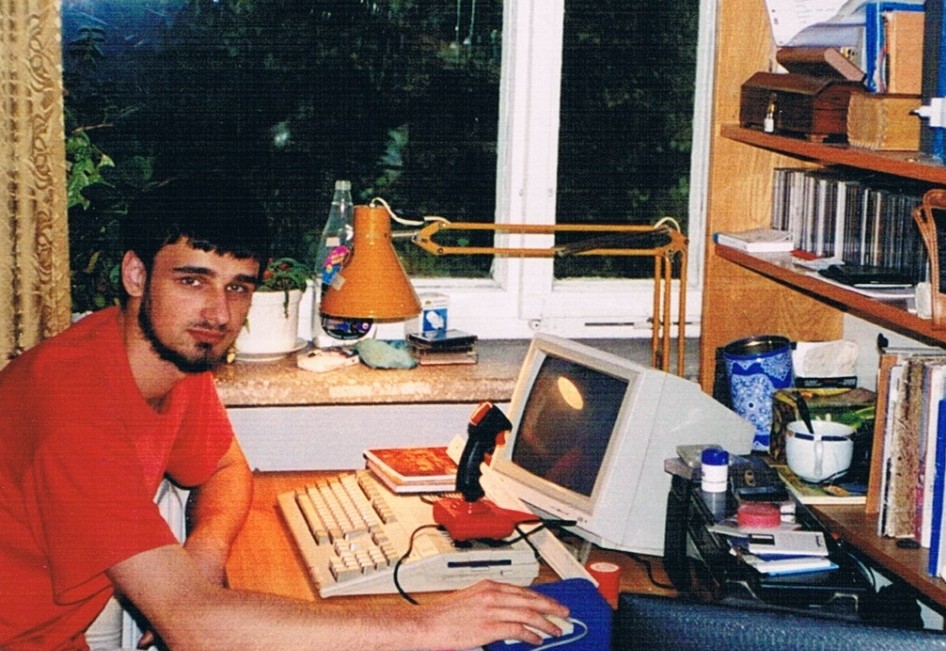
September 1996 — Aleksander in his cave
Audio
Quadrofonietta
Programme note
Quadrofonietta was written in 1996 on commission from the Silesian Days of Contemporary Music. It was premiered on 30 September 1996 in Polish Radio’s Large Studio in Katowice. In the festival programme, the work was listed as a composition “for gadułka and tape” — and that was the form in which it was heard at its premiere.
Space came first.
I wanted the music to unfold not in front of the listener but around them — and to be heard not as four separate sound sources, but spherically. Four loudspeakers, two in front and two behind, marked out a physical square. Yet this angular “squareness” was only a technical scaffolding for a space whose true shape was to be created by perceptual imagination: soft, continuous, transformational, surrounding, somehow “infinite”.
It is meant to contain something of the entry into a forbidden room described by Mircea Eliade and of suddenly finding oneself as though inside a grape: something of a furtive passage into an unknown land, understood only intuitively, forbidden but promised; of the roundness of the vine’s fruit and of sun-suffused green, drowsy, so very different — from what?… when we are inside.
This is the space of Quadrofonietta.
Its tension develops through the addition of successive dimensions. The motif first appears as a point, monophonically, in a single loudspeaker; from another point in space, an “intelligent echo” answers it. Monologues turn into dialogues, dialogues into mirror reflections in time and space, and these into ever denser sonorities and timbral unifications. The point gains a line and a circle, the monologue — an answer and a dialogue, the square — a sphere. Each successive state does not annul the previous one, but adds a dimension to it: it leads higher or deeper, from separation towards integration, from multiplicity towards wholeness, towards the Self.
Four was not merely a consequence of the technical arrangement of the loudspeakers. Even then, the Quaternity — also as a double pair of opposites — was for me an ontological, philosophical, psychological and artistic point of reference. This did not mean privileging one number. Three, seven, nine, ten, twelve, thirteen — and quite a few other numbers too — had always carried for me their own weight, symbolism, capacity for meaning and separate storehouses of inspiration.
The single-movement work, lasting 12 minutes and 22 seconds, consists of four “chapters”, within which a total of twenty attacca episodes can be distinguished. In the compositional plan, each was given a “narrative” title-name: psychological, literary or autobiographical.
For the listener, what matters is not so much those “intimate” meanings — let them remain a secret for now — as their mutual relations, occurring directly or at the macroformal level. The listener will therefore fill the music, autonomous in its concert projection, with their own symbolism; yet that symbolism is intellectually “steered” by the composer, who wants to influence as precisely as possible the play of expressions arising both at the level of musical micro-meanings and within the architecture of the whole.
To this end, repetitions, similarities, references, contrasts, oppositions and collisions are deliberately dosed — mathematised in the computer layer, intuitive in the instrumental parts overdubbed later.
Acoustic structures travel between the loudspeakers, carry one another’s utterances further and complete one another. Emotions and processes that could readily be described with such terms as coniunctio, fermentatio, mortificatio or Mercurius, at times, as if exhausted, die away, only to gain at once a new impetus and “will”, energy in successive launches-soarings.
Surrounding atmospheres and timbral unifications also emerge — among them the “String Organ”: this climactic, slow phrase recalls the timbre of a church organ while at the same time trembling tenderly like a spectral instrument vibrating across multiple octaves, excited by a bow — as if, on top of that, its sound were coming from the maw of a tender giga-gramophone on which a drunken DJ is playing.
The brief finale sums up, in retrograde, without changing the pitches but with an agogic diminution, the entire earlier “story” and turns out to be, as it were, the Self — in the sense used by C. G. Jung — of this work-organism. All three earlier chapters run from end to beginning, superimposed on one another and fitted compositionally anew into different temporal and contextual conditions. There is déjà vu here, or perhaps rather déjà entendu: a mirror in time in which the work’s entire memory up to this point appears all at once in reverse motion. A four-channel panoramic delay additionally sets it moving around the listener.
Melding natural and computer-processed sounds into a single flow, creating measured proportions between what is by nature opposed and what brings an intraformal bond, seeking accord between number and the “fantasies of the heart” — and therefore something like hieros gamos — these are the sources of the compositional imagination and vision.
It was a completely different world of working with digital sound from today’s. Pro Tools at the time already made possible things that had previously seemed unimaginable to me, but each had its own physical time. Time-stretching several minutes of material could mean waiting as long as an hour for the computer to recalculate the sample — with no certainty that the operation would succeed at all. One could come up from the underground studio, drink a coffee, return — and find on the Mac’s screen only: Error.
If the computer did make it safely to the end, however, a peculiar moment arrived: the result already existed, but I did not yet know it. I pressed “play” with a mixture of anxiety, hope and curiosity, as before checking a lottery ticket. Only the first listen told me how high and how great the music I had won was. Today similar operations take less than the blink of an eye; that waiting cannot be forgotten.
Quadrofonietta stood at the meeting point of several of my worlds at the time. There was the double bass — the instrument I had grown up with. There was the gadułka, newly brought back from Bulgaria — demanding a special “fingernail” playing technique. There was the Commodore 64, which I was already using as an instrument. And there was the increasingly powerful world of Macintosh computers, Pro Tools and the studio’s digital possibilities.
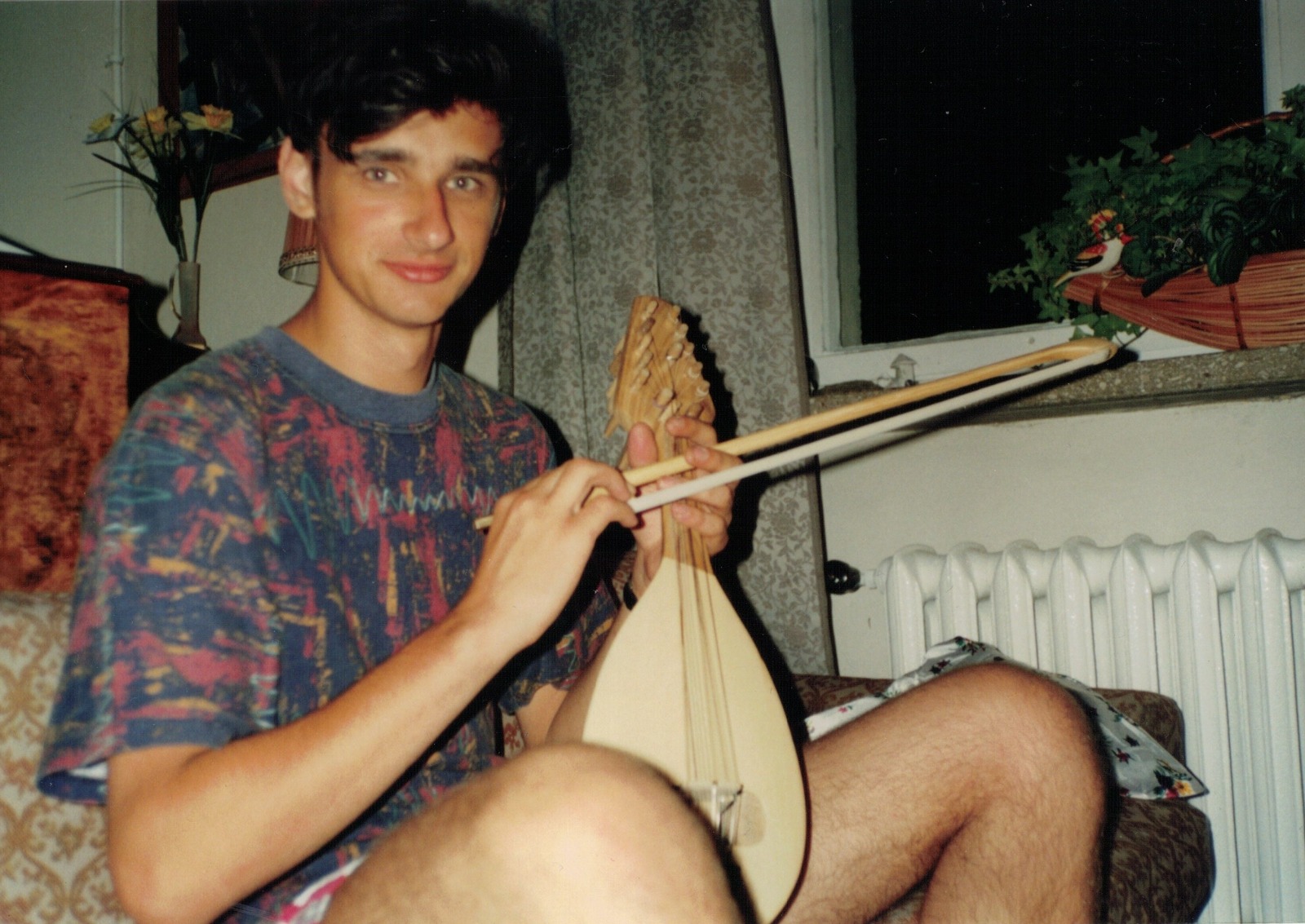
Later performances of Quadrofonietta did not remain tied exclusively to the forces heard at the premiere. The double bass returned to the instrumentation, and a Commodore 64 also appeared, used by me live as an instrument. Stereofonietta was created as well — not as a separate composition, but as a stereophonic derivative of Quadrofonietta, allowing the same work to be performed in venues without a four-channel loudspeaker system — and the absence of such a system was the norm for us in the 1990s.
From today’s perspective, I also see Quadrofonietta as the first link in a later line:
Quadrofonietta — Folklorietta — Aleksandrietta — Glorietta.
I call it my Holy Quaternity. It is not a cycle in the traditional sense, nor a series of variations on the same material. What connects these works is rather a shared genetics of building emotion — something that in 1996 did not yet have its later names, but was already present in Quadrofonietta.
A space appropriately soft, continuous, transformational, somehow “infinite”, surrounding — exploding with seed-genes: a shape of fruiting, of an ovary of sounds, forms, hopes.